Overview
Overall Condition Index (OCI) Survey Procedure
The inspections were conducted using the OCI survey procedure documented in the "ASTM D6433-18, Standard Practice for Roads and Parking Lots Pavement Condition Index Surveys" publication. The OCI procedure is the standard used by the transportation industry to visually assess pavement condition, providing engineers with a consistent, objective, and repeatable tool to represent the overall pavement condition. During a OCI survey, visible signs of deterioration within a selected sample unit are recorded and analyzed, as are distress type, severity, and quantity.
The results of a OCI evaluation provide an indication of the structural integrity and functional capabilities of the pavement. However, it should be recognized that during a OCI inspection only the top layer of the pavement is examined and that no direct measure is made of the structural capacity of the pavement system. Nevertheless, the OCI does provide an objective basis for determining maintenance and repair needs as well as for establishing rehabilitation priorities in the face of constrained resources. Furthermore, the results of repeated OCI monitoring over time can be used to determine the rate of deterioration and to estimate the time at which certain rehabilitation measures can be implemented.
Relationship to Repair Types
In general terms, pavements with relatively high OCIs that are not exhibiting significant load-related distress will benefit from preventive maintenance actions, such as crack sealing and surface treatments. As the OCI drops, the pavements may require major rehabilitation, such as an overlay. In some situations where the OCI has dropped low enough, reconstruction may be the only viable alternative due to the substantial damage to the pavement structure. The figure below illustrates how the appropriate repair type varies with the OCI of a pavement section.
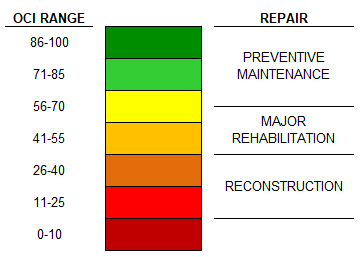
The types of distress identified during the OCI inspection provide insight into the cause of pavement deterioration. OCI distress types are characterized as load-related (such as alligator cracking, corner breaks, and shattered slabs), climate/materials-related (such as weathering [climate-related] and durability cracking [materials-related]), and other (distress types that cannot be attributed solely to load or climate/materials). Understanding the cause of distress helps in selecting a rehabilitation alternative that corrects the cause and thus eliminates its recurrence.
The “Causes of AC Distress” and "Causes of PCC Distress" pages in this section contain tables for asphalt and PCC pavements, respectively, indicating the typical types of distresses that may be identified during a OCI survey, along with a brief description and the likely cause of each distress type.